SW_002 Eating Together (27 September 2025)
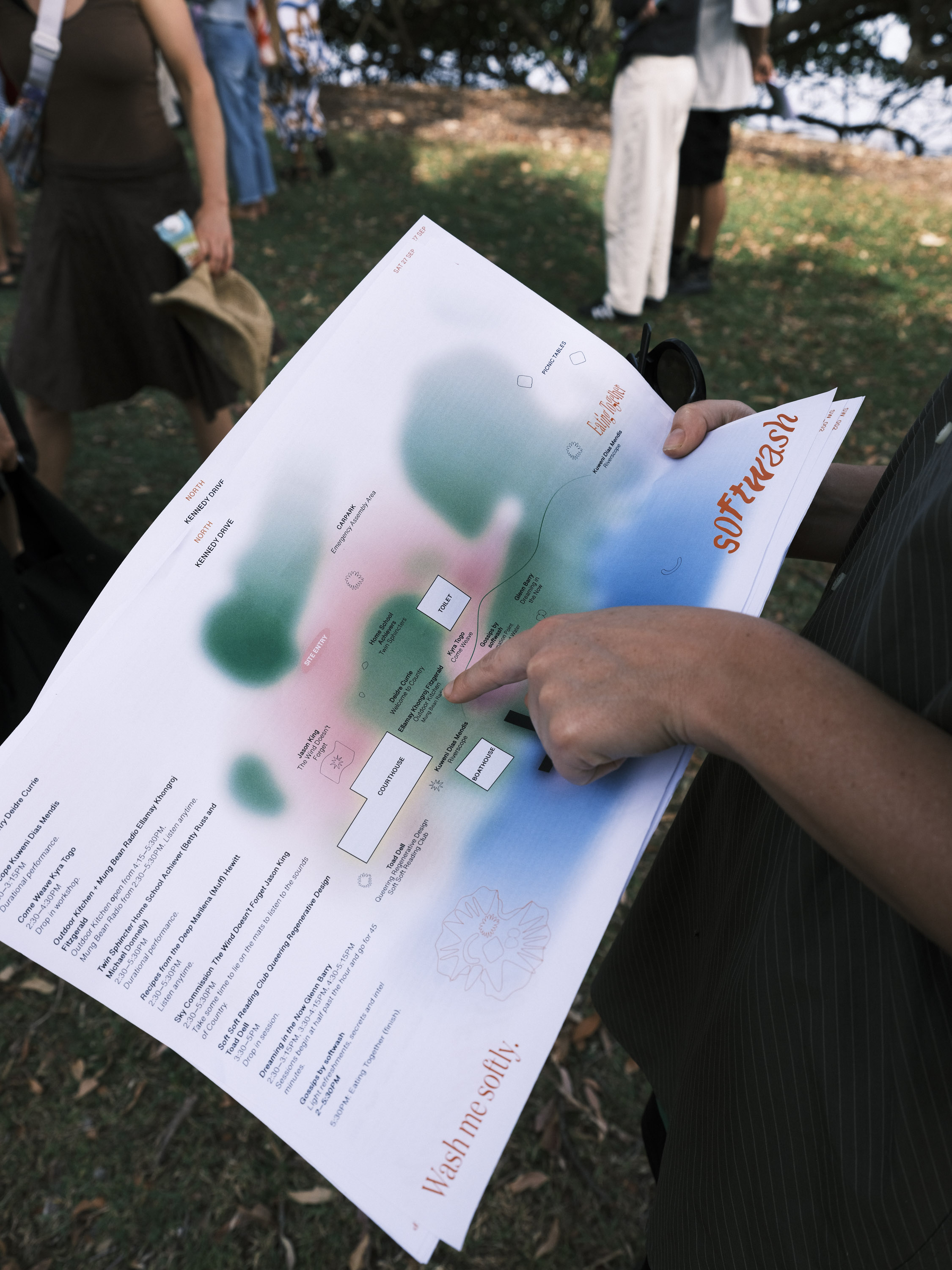
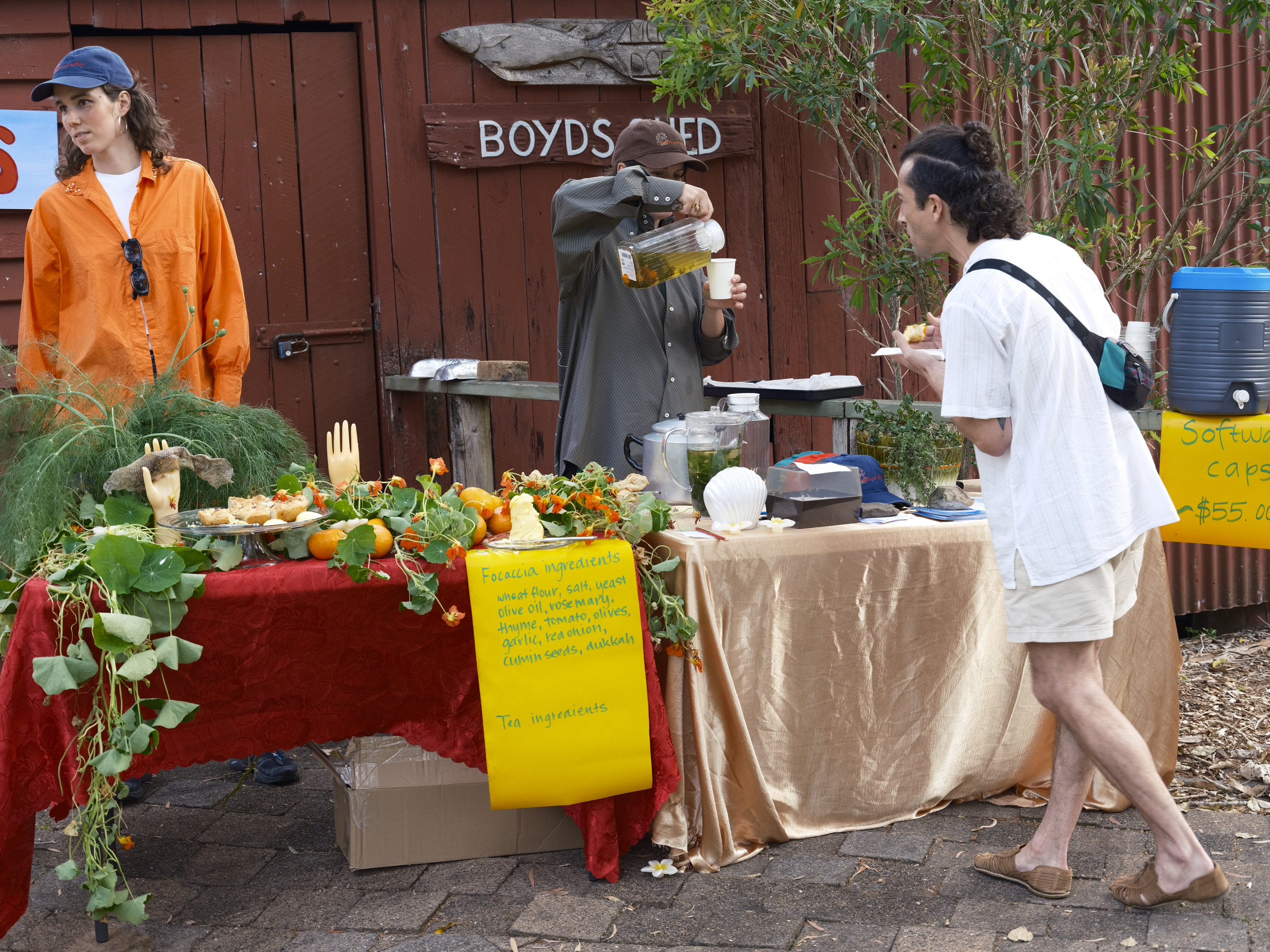
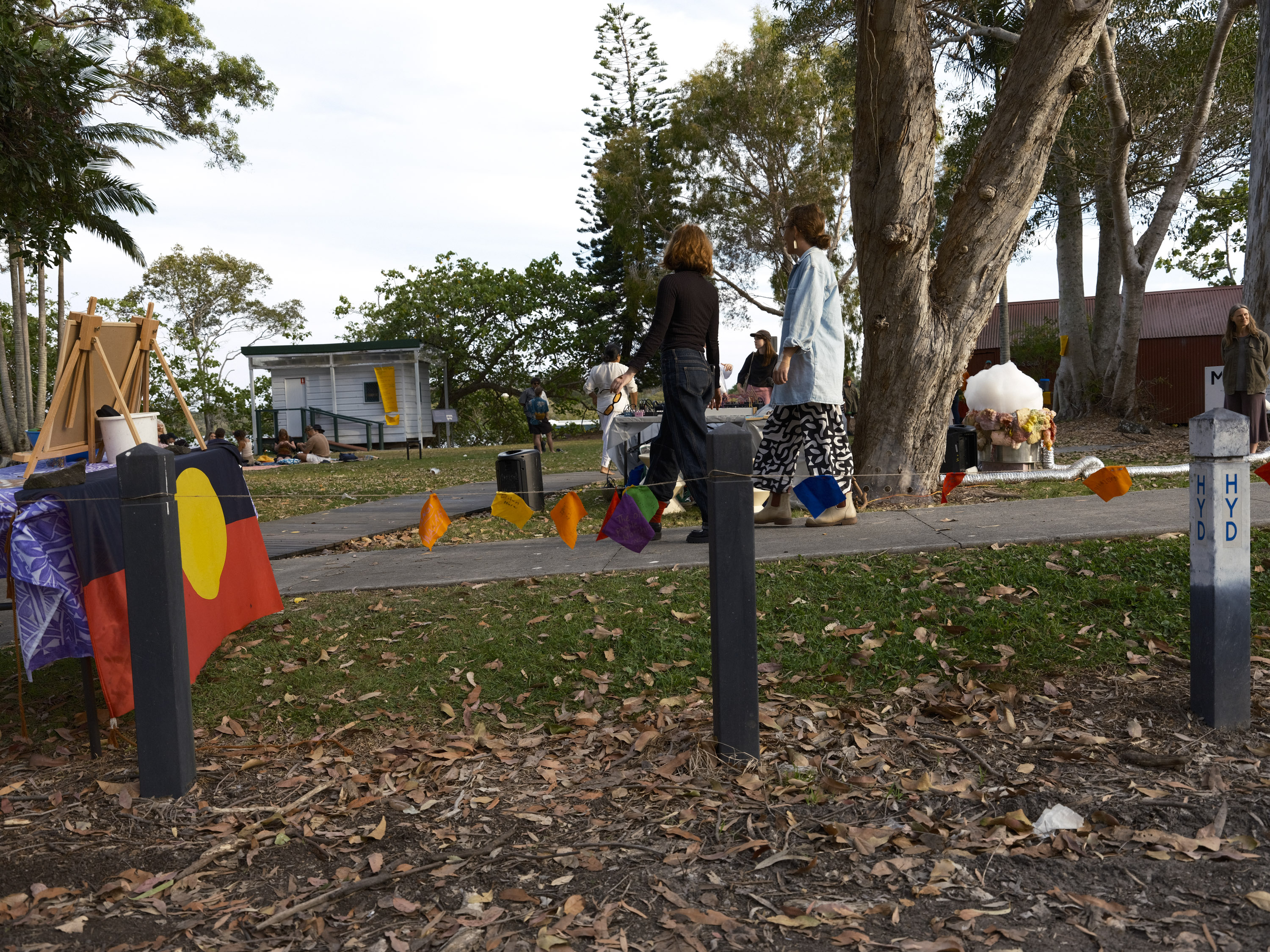
Eating Together focused on rituals of gathering and the social systems that shape how we relate. softwash invited artists and audiences to consider the conditions of continued togetherness, using food, shared processes and participatory actions as frameworks for connection. Works explored borders between people, cultures and ways of being, offering moments of generosity, feasting, hospitality and intimate exchange.
Featured artists: Deidre Currie, Jason King, Home School Achiever (Betty Russ and Michael Donnelly), Kuweni Dias Mendis, Glenn Barry, Marilena Hewitt, Kyra Togo, Ellamay Fitzgerald and Toad Dell.
︎
softwash was an artist-led program of experimental, site-responsive live art presented on Bundjalung Country | Tweed Heads. Across three free events, softwash reimagined the public parklands at the Tweed Regional Museum Learning Site as a place for artists and community to gather, share and make meaning together.
This program was assisted by the Australian Government through Creative Australia, its principal arts investment and advisory body, made possible with auspicing from The FARM, development support from City of Gold Coast, and venue support from Tweed Regional Museum and Arts Northern Rivers.
SW002 photography by Buzz Gardiner.
View the softwash archive on Substack and Instagram. softwash design by Marilena Hewitt.
︎
Marilena (Muff) Hewitt Recipes from the Deep
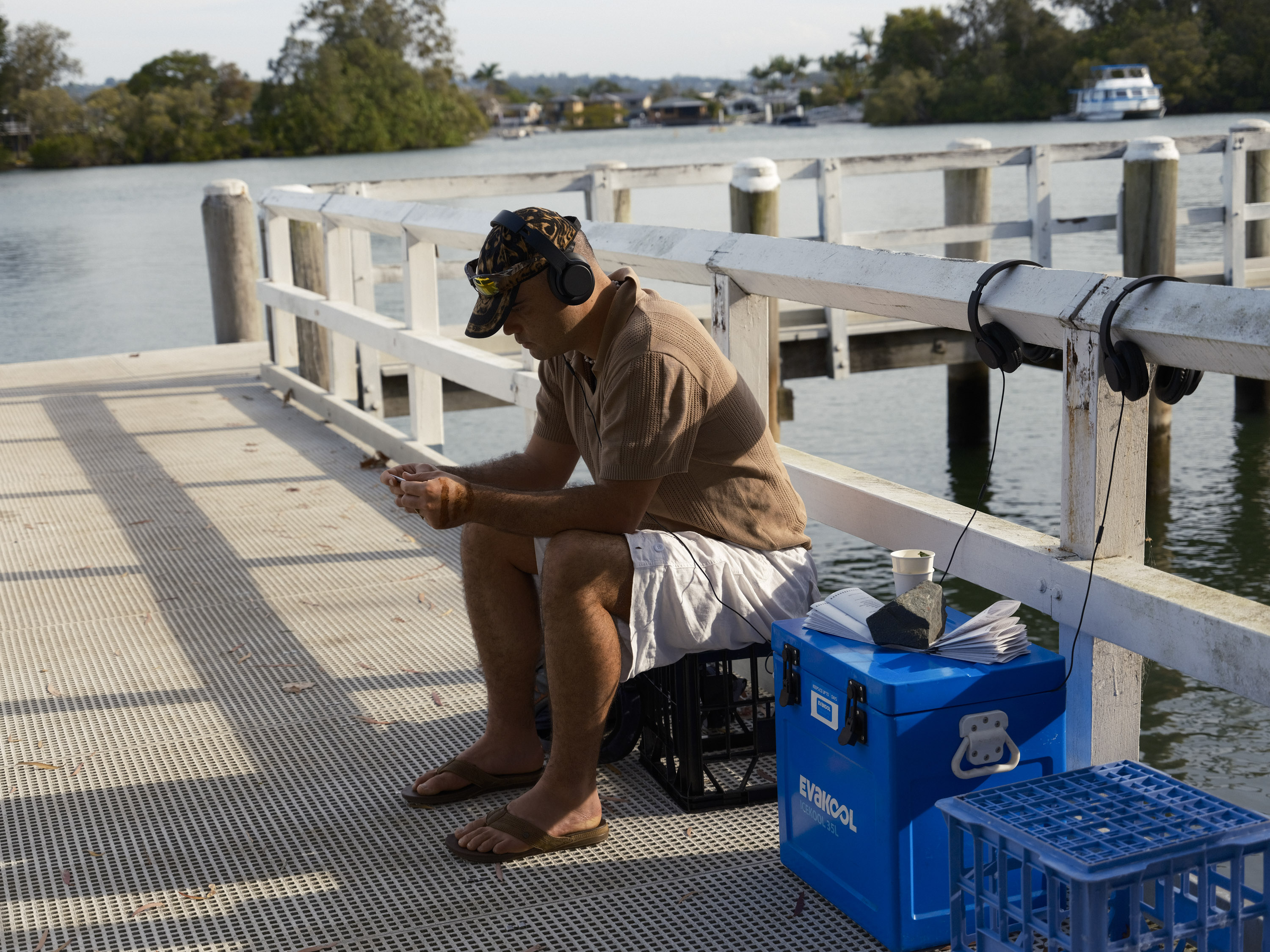
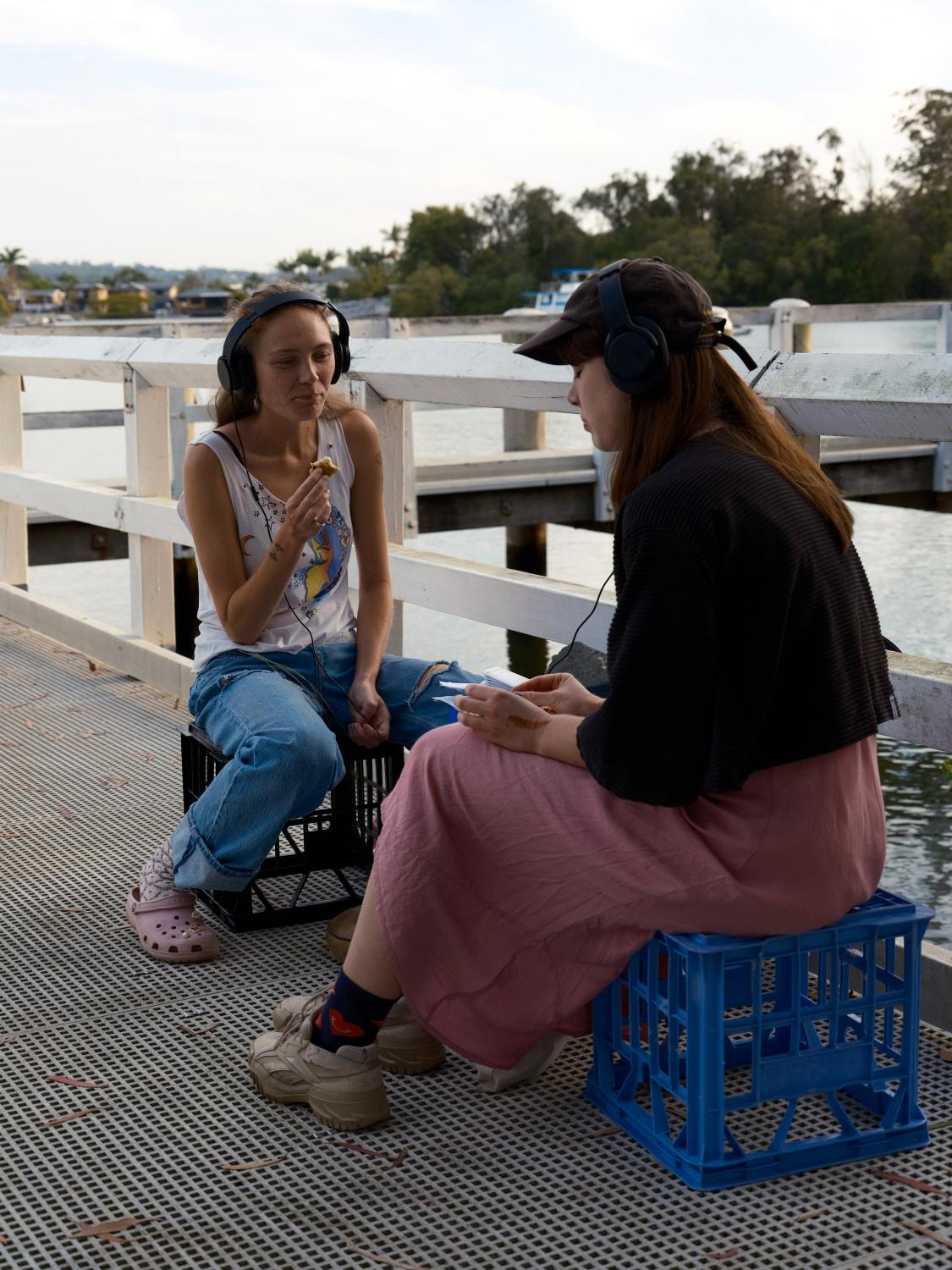
These NonaBoy pros and sea creature sonars draw from lines. Lines that move. Boundaries that slip. Tides that echo in circles — in queer time. ‘Recipes from the deep’ is unsure of itself. It is janky and BENT. It's Tweed. It is "I don't have to understand you to love you." It's a carrier shell holding ocean debris; it's dolphins sponging for fish; it's rising seas, sea hare chains and the whole world cumming at the same time; it is flirting and making a mess; it's cosmopolitan distribution (biogeography) and tidal flushing; it's jellyfish satellites communicating the message.
The core message. The one holding dark heavy minerals and compacting the bright sun all at once, as if nothing expires. As we remix we become more sure. As we listen we get closer to the corner.
Marilena or Muff (NonaBoy/they/them) is a poet, designer, artist and publisher living and working on unceded Jagera and Turrbal land. Their transdisciplinary practice acknowledges the importance of staying in trouble together whilst imagining a future which looks fuller, brighter, vaster and more empathetic. Their arts publication PLATYPUS is unique in its approach to ecological crises. It is guided by First Nation’s cultural practice, artmaking, critical discussion, poetry, humour, queer ecology; and is informed by fieldwork. For Marilena, frolicking/crying/laughing in the field is the only way to create relationships with other bodies; bodies as bioregions, bodies as more-than-human. Their poetry navigates, flirts and fails at complex relationships between ecology, weather, gender, sexuality and mass extinction.
LISTEN to Recipes from the Deep | READ the tracklist
︎
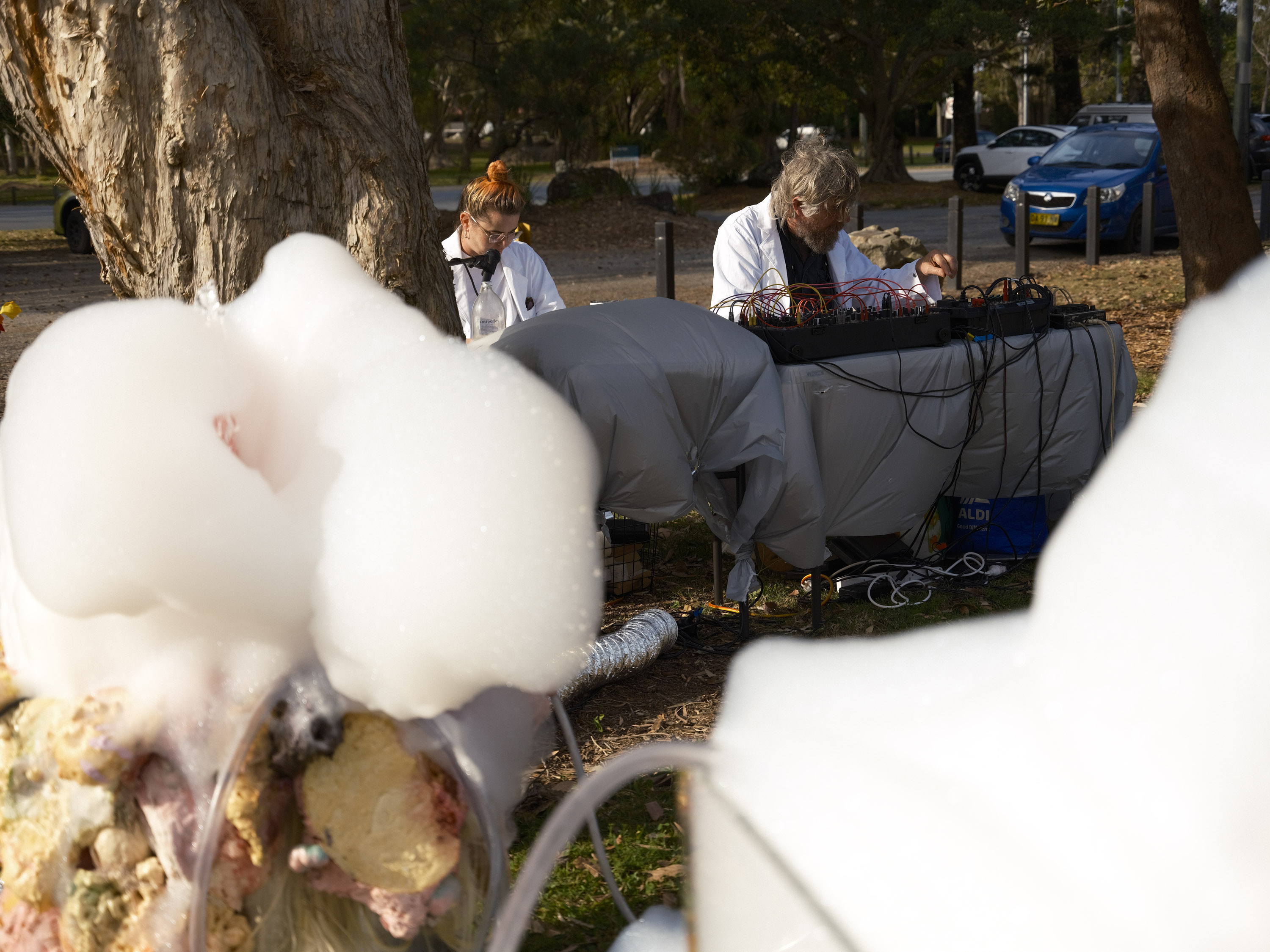
Home School Achiever (Betty Russ and Michael Donnelly) Twin Sphincter
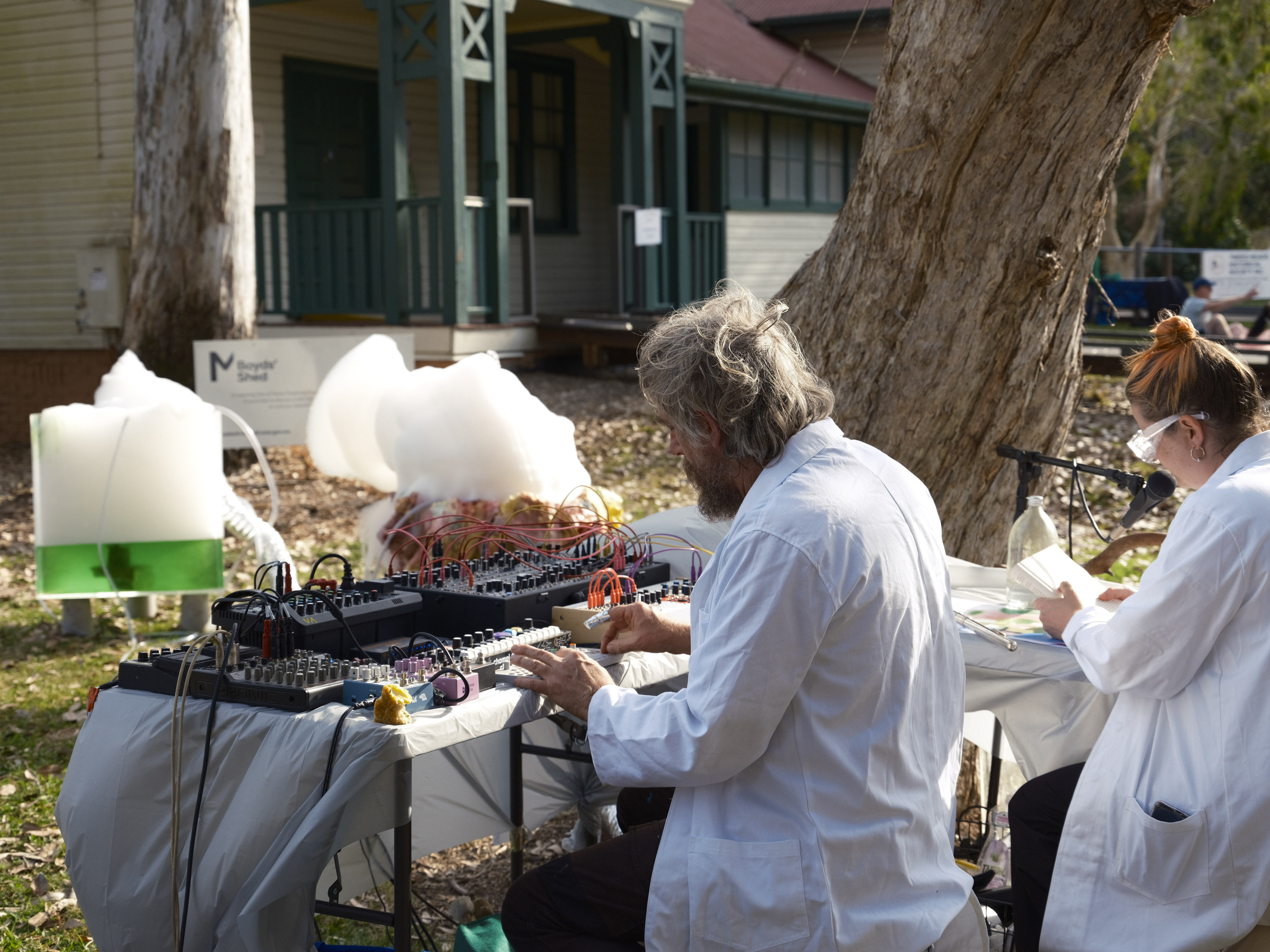
Twin Sphincters (POOPING BACK AND FORTH FOREVER ))>><<(() reflected a world warped by technological absolutism, where unchecked systems of power entwine with capitalism’s fevered rush of consumption and desire, where organisms are no longer simply alive but endlessly commodified, mutated, and repurposed to appease the abstract appetites of capital. But what appears grotesque is also generative: decomposition as choreography, excess as fertile ground, thresholds where rot and growth entwine. Learning to inhabit the mess, to recognise survival as a practice of entanglement and embracing the chaos unfolding, is our only hope.
Home School Achiever (Betty Russ and Michael Donnelly) Drawing on the fringes of popular culture, Home School Achiever creates objects, installations, and situations that suggest shifting meanings rather than fixed conclusions. Their practice thrives on ambiguity and invites audiences into a fertile space where cultural residues, speculative thinking, and material experimentation collide.
*Pooping back and forth forever references Miranda July Me and You and Everyone We Know. 2005. IFC Productions.
︎
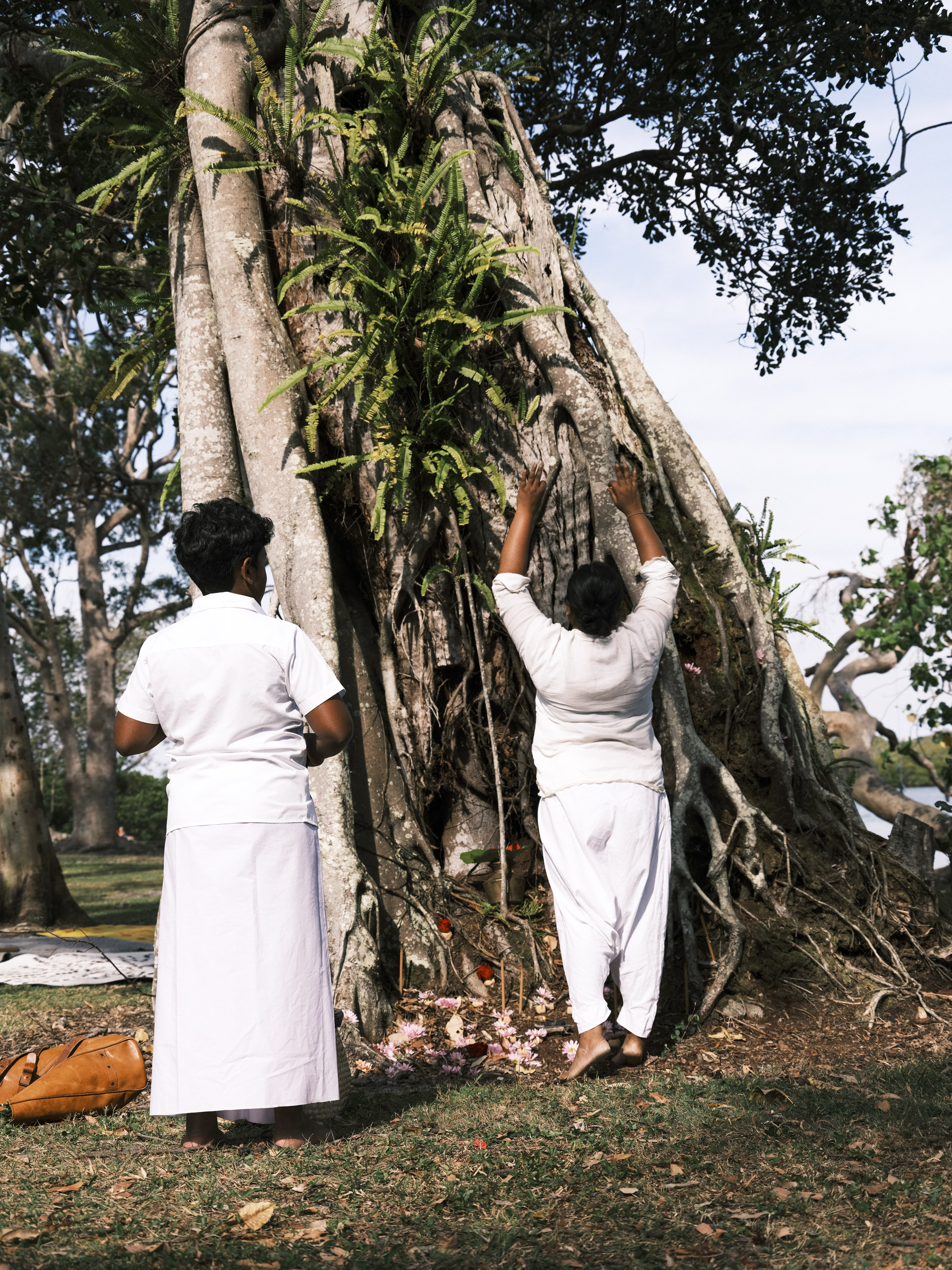
Kuweni Dias Mendis Riverscope
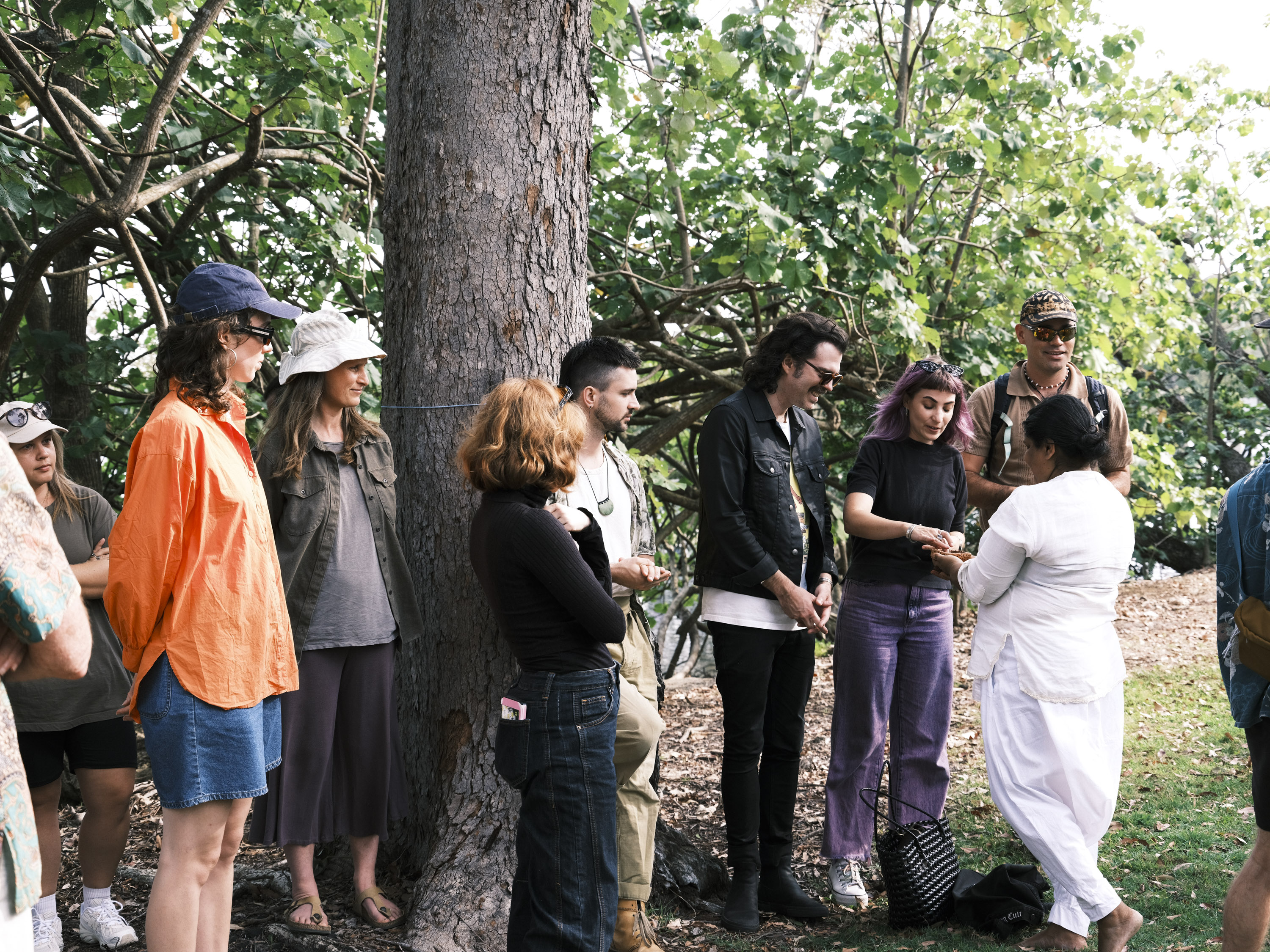
Kuweni Dias presented a site-responsive performance and installation rooted in ritual and pilgrimage traditions from her Sri Lankan ancestry. Appearing as a pilgrim, she arrived to sense the site, created place to feel at home, and connected with community through the ritual of coming home and sharing a meal.
This participatory work invited audiences to engage in marking space and presence, contributing to a living archive of resonance. The performance culminated in stillness, reflection, and a shared act of connection, care, and reciprocity that extends the circle of belonging.
Kuweni Dias Mendis is an artist who integrates movement, sound, film, installations, markings, and sculptural ritual objects to create immersive works that invite audiences into direct, embodied experiences reconnecting them to their heartbeat, rhythm, gait, posture, and sense of time and space within a decolonized body. Her practice is deeply shaped by her hybrid cultural experiences between Sri Lanka and Australia. Kuweni blends regenerative practices, arts activism, and cultural facilitation, using ritual and ceremony as vessels for artistic expression. Through practice-led research, she explores her role in preserving a vanishing heritage. As a migrant woman of color on unceded lands, she advocates for and amplifies the voices of marginalized women through collaborative artworks, exhibitions, and participatory experiences. She strives to create spaces where these voices can be heard and valued.

︎
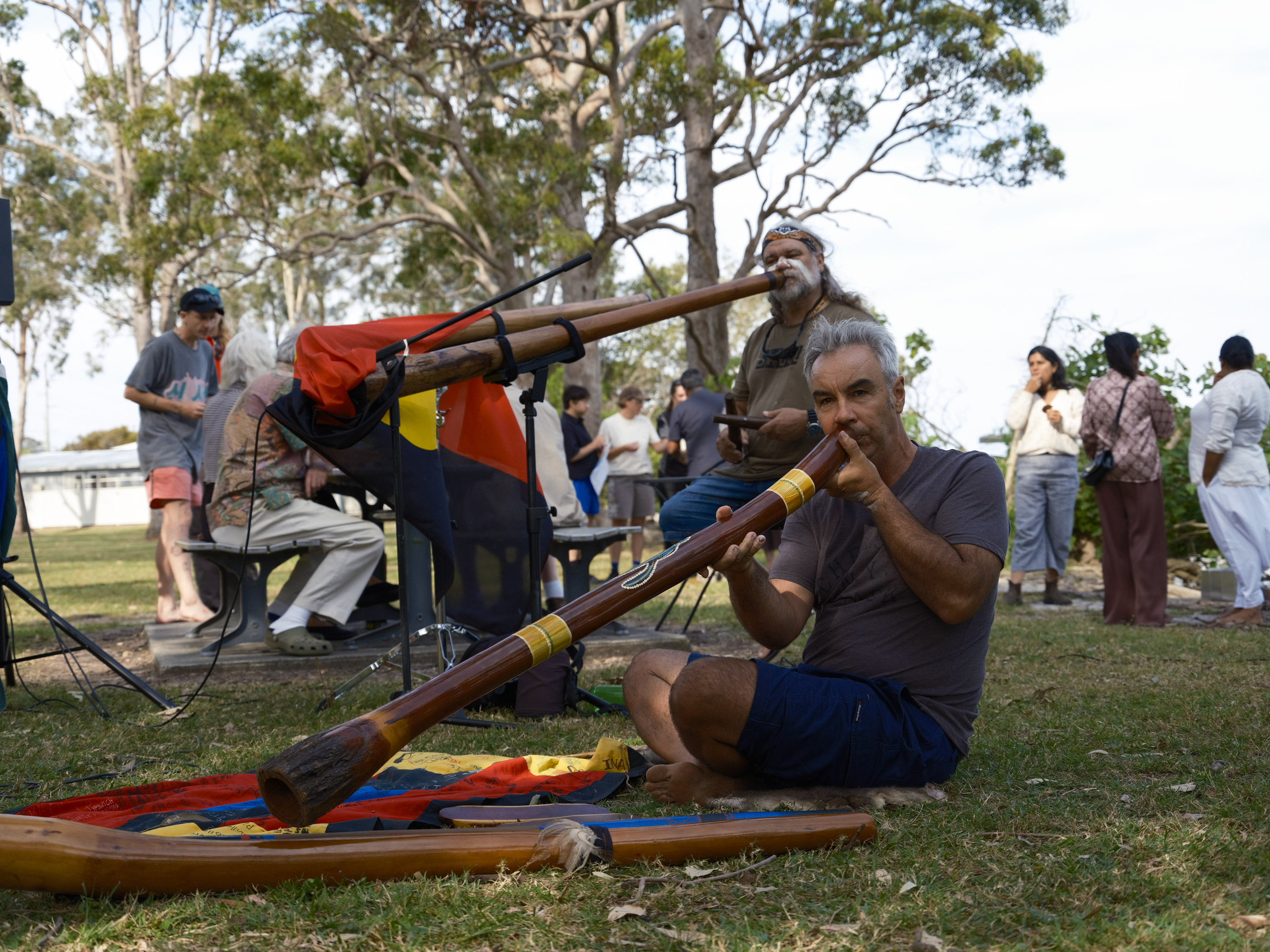
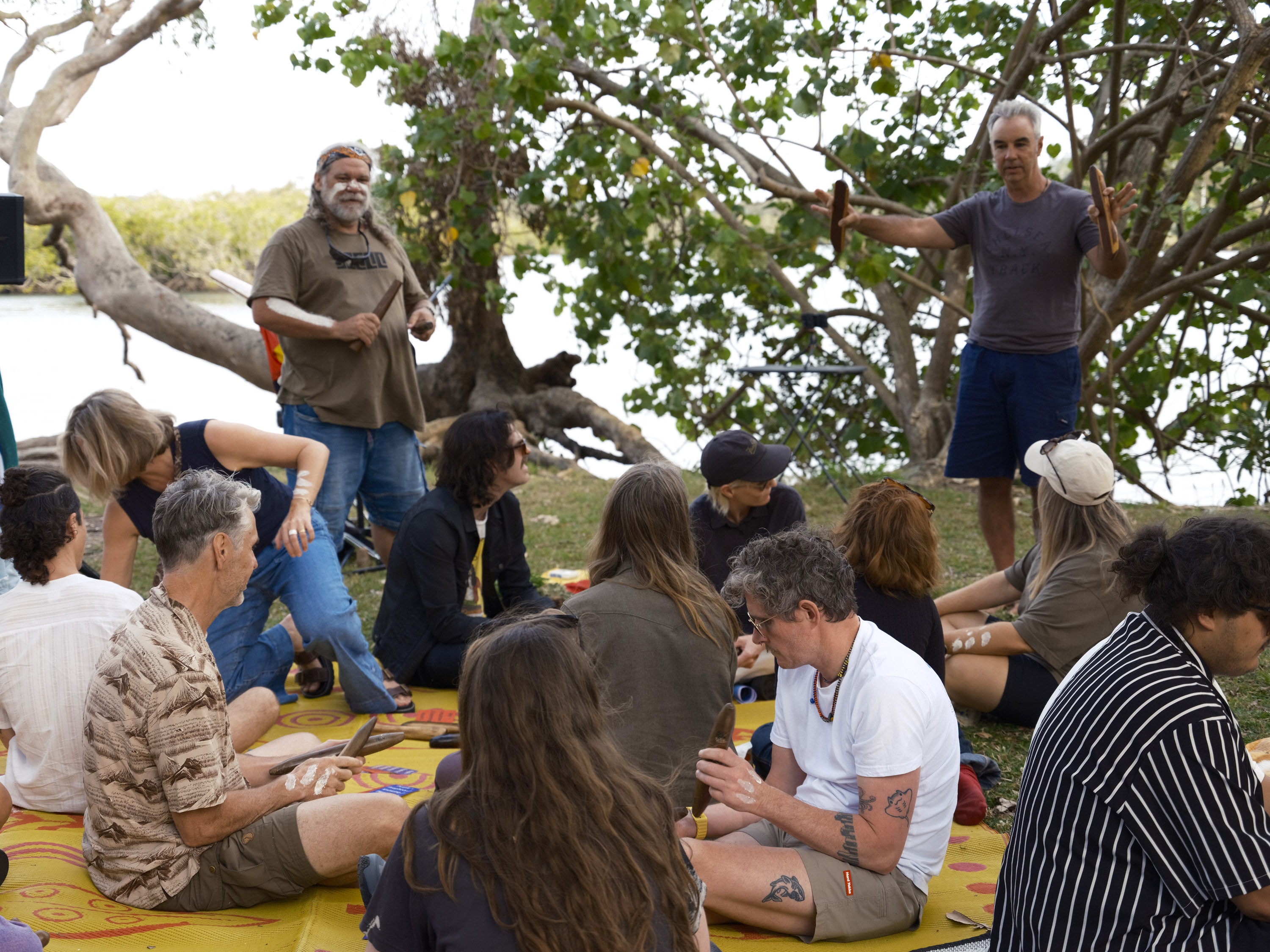
Glenn Barry Dreaming in the Now
Gali Guwaay Gulibaa – Water, Words, and Spirit Weaving
Aboriginal meditation and sound healing with Glenn Barry, Gamilaraay.
Glenn invited participants to immerse their Gii Dhuwi – heart and soul with Aboriginal spirituality through heartfelt meditation, sound healing and reflective yarns on sacred country. We deeply listened with calmness and then guwa li – speaking from our inner voices.
Glenn aligns with his Gamilaraay First Nation of Australia and Irish DNA. As a PhD Candidate with the Qld. Conservatorium Griffith University researching the spiritual wellbeing and healing of First Nation music, he works alongside community to support identity agency. He utilises vibrations from the art of Yidaki (Didgeridoo) to bring gii/dhuwi (heart and soul) into the world of authentic feeling. Glenn's goal is clear communication through bridging values of both traditional and contemporary worlds: a “trademporary” world in this 21st Century. Many Bloods. One World.
︎
![]()
![]()
︎
Ellamay Khongroj Fitzgerald Outdoor Kitchen + Mung Bean Radio
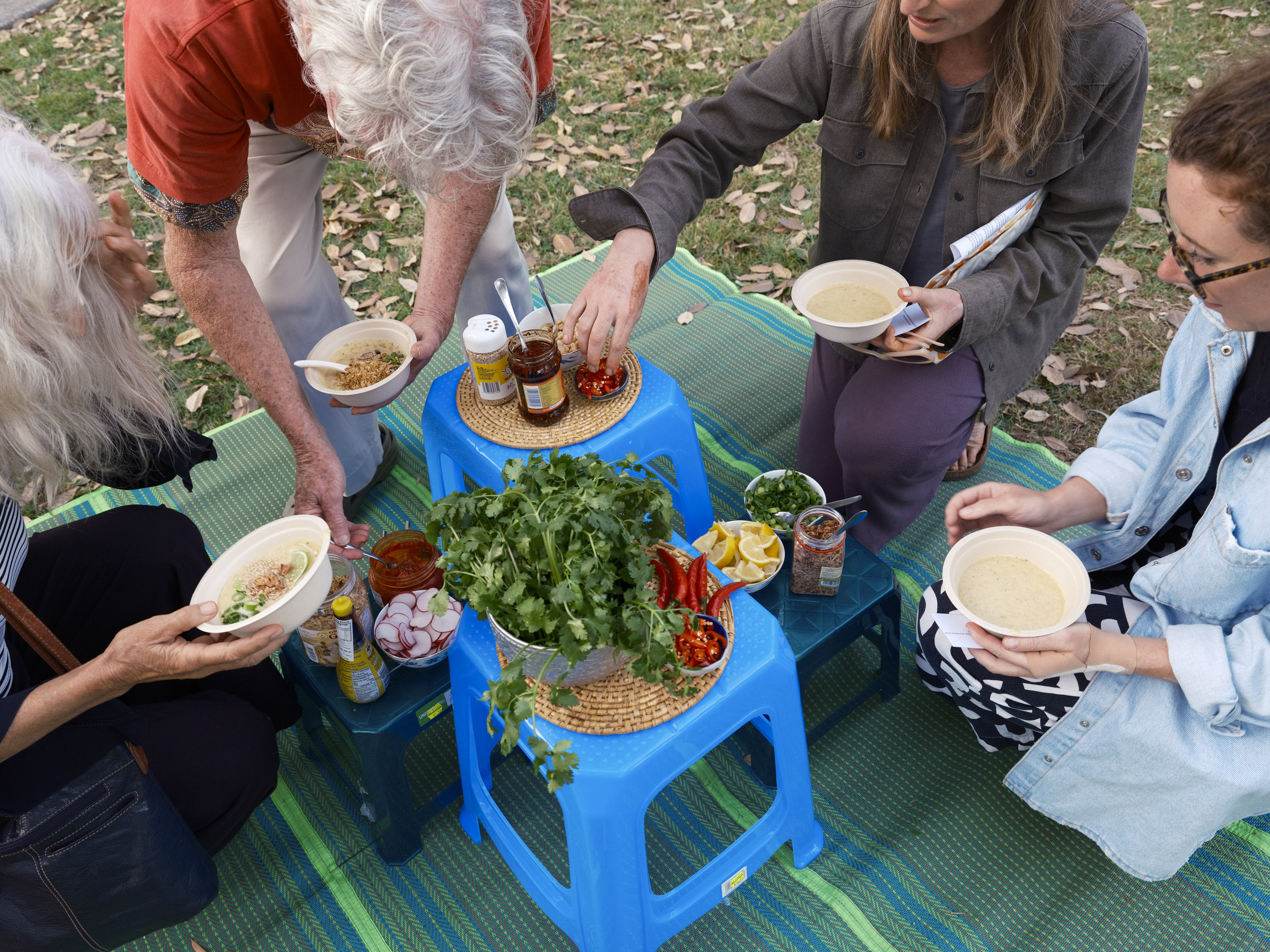
Outdoor Kitchen was a participatory installation that reimagined a dining space, where cooking and conversation became tools for connection. Ellamay Khongroj Fitzgerald prepared congee with a mish-mash of Eastern and Western ingredients, reflecting on her own bi-racial identity and the way she navigates the space between two cultures.
For Ellamay, cooking and eating together has always been a way to reconnect with her father’s side of the family after growing up disconnected from her Thai heritage. Each shared meal builds upon a personal archive of memories, feelings, and stories that help piece together a sense of belonging.
Outdoor Kitchen invited visitors to partake in a bowl of congee and consider, how does sharing a meal change the experience of eating it? What does it mean to gather together, to exchange stories, to taste something unfamiliar yet comforting? Through the act of cooking, serving, and eating, the work creates space for reflection on how food shapes belonging, identity, and connection across cultures.
Mung Bean Radio
“what destroys you can also nourish you.”
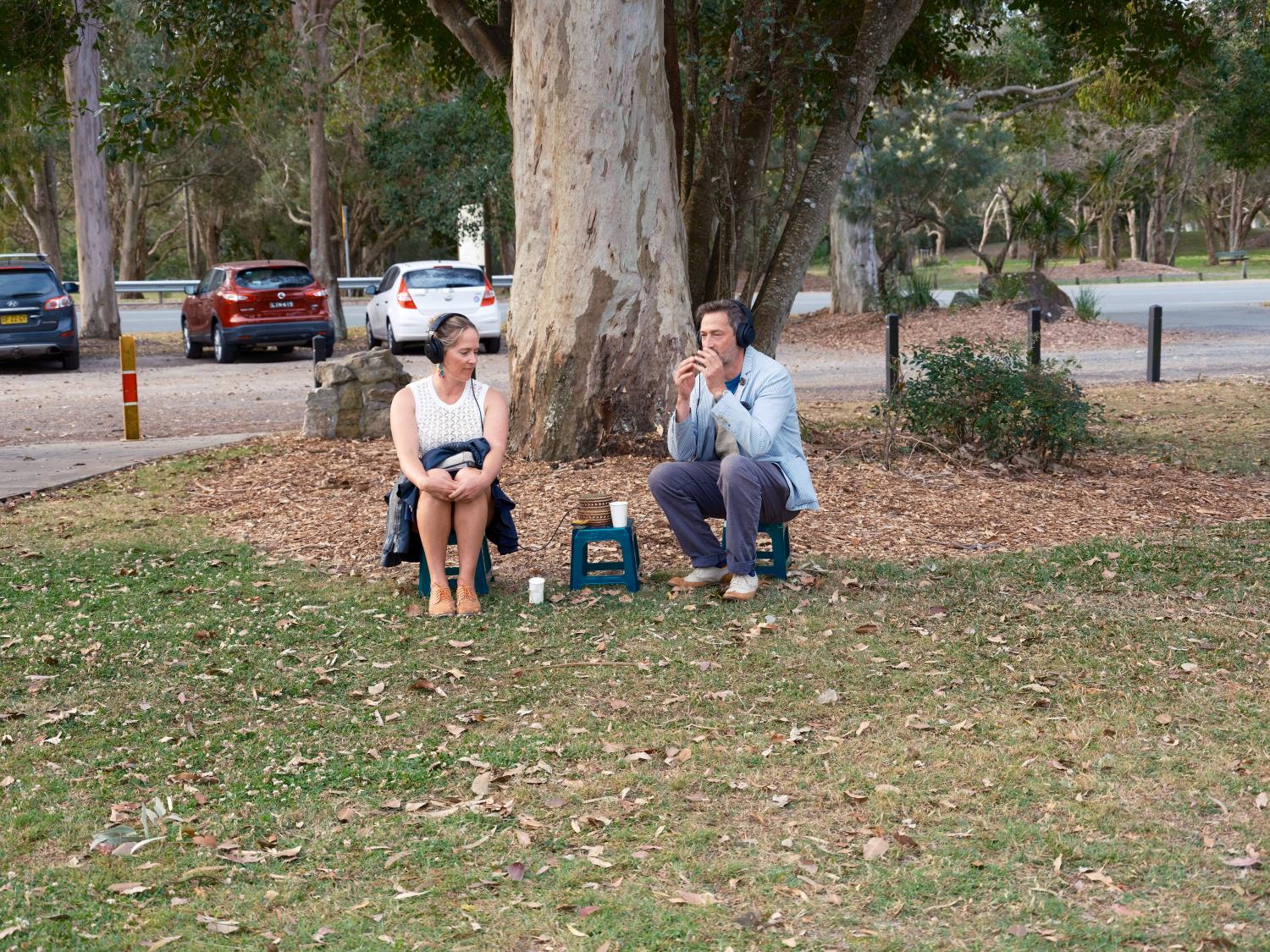
Through headphones emerging from a basket of mung beans, Filipino-Singaporean Mariam Ella Arcilla recalls the childhood punishment her grandmother gave her, later transformed into a meal both nourishing and delicious.
Ellamay Khongroj Fitzgerald is an emerging artist based on Yugambeh Country. Her practice spans across lens-based storytelling, installation and participatory forms of making, through which she explores her dual Australian and Thai heritage. Ellamay's work is largely influenced by her lived experiences growing up bi-racial on the Gold Coast and perceptions of culture, identity and place as a second-generation Asian Australian.
![]()
![]()
![]()
︎
Toad Dell Soft Soft Reading Club: Queering Regenerative Design
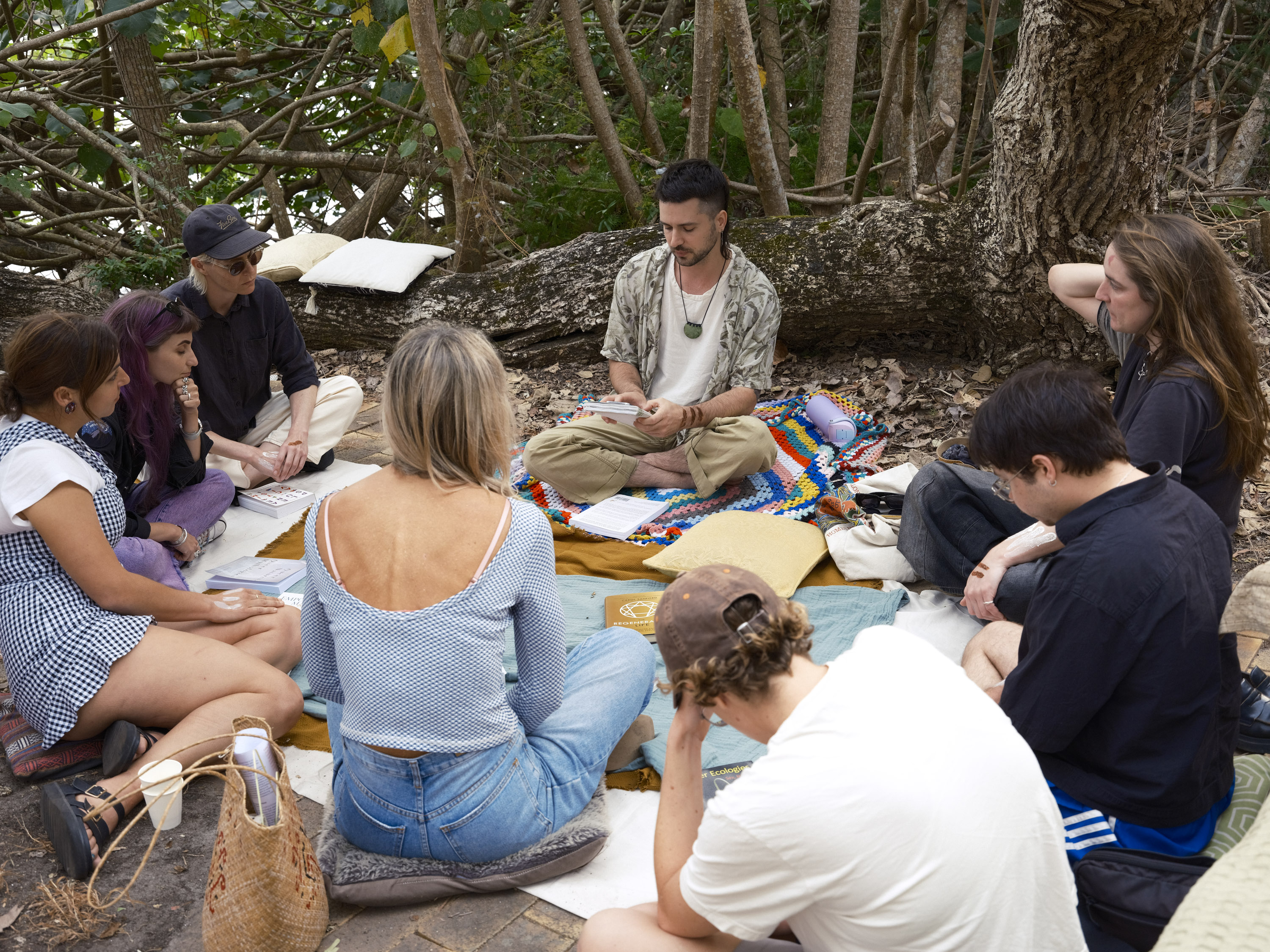
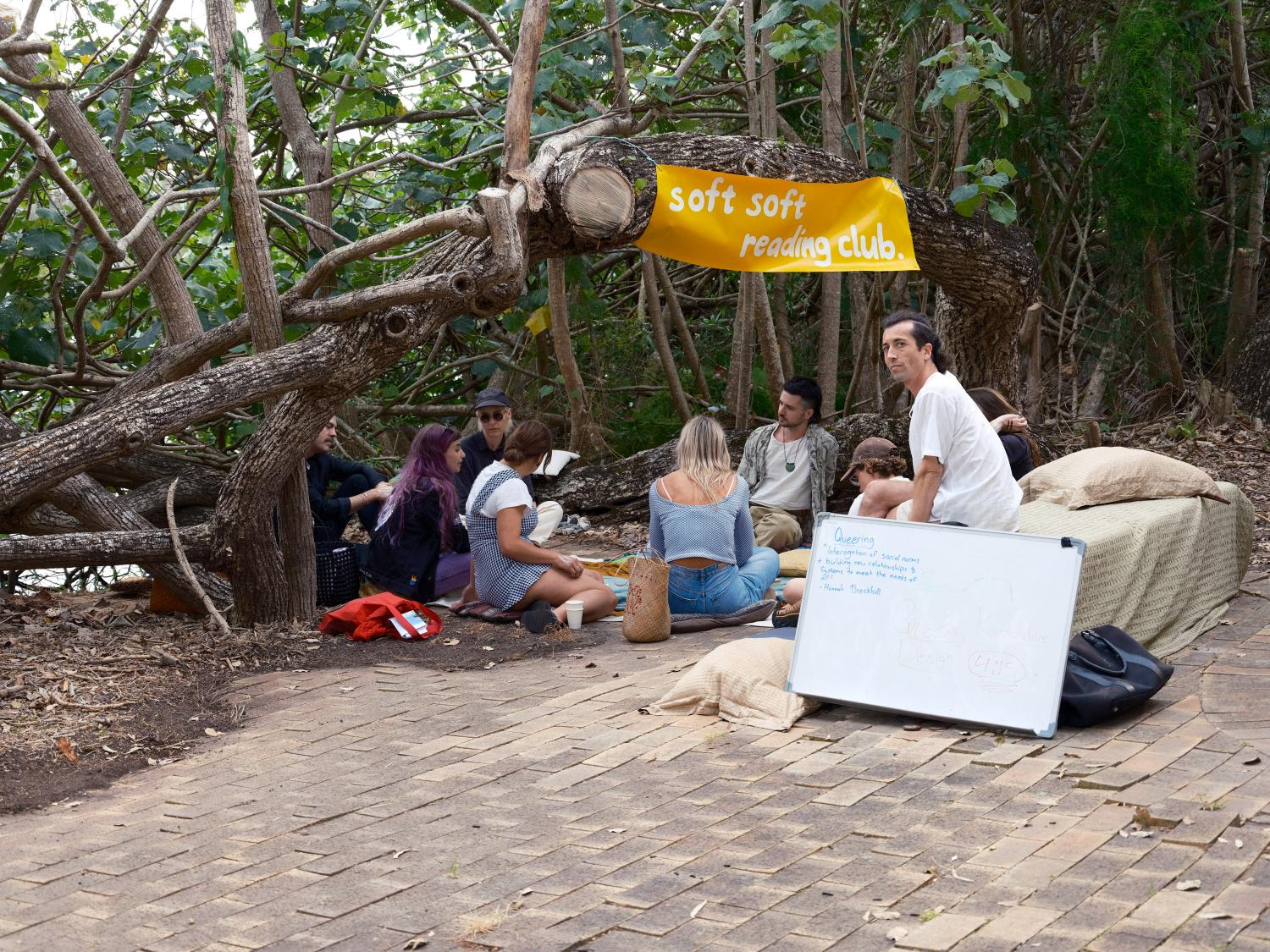
This intentional practice of Queering interrogates norms to build new relationships and systems that meet the needs of all. In a time and culture of siloed extraction, how do we queer ourselves and the systems we live within? How do we find our edges, locate where they touch others and design a social ecology of strong relationship rather than productivity? Drawing from ecological literacies, systems thinking & permaculture, this space explores how we relate to the everpresent "Other" that is often vilified. Let's practice pausing and deep listening to reveal pathways forward of collaborative and regenerative ways of being.
Toad is a permaculture designer, community organiser and co-founder of PermaQueer. Most of their practice sits at the intersection of social and ecological care with care-full design from a queer theory perspective.
![]()
![]()
︎
Jason King The Wind Doesn’t Forget
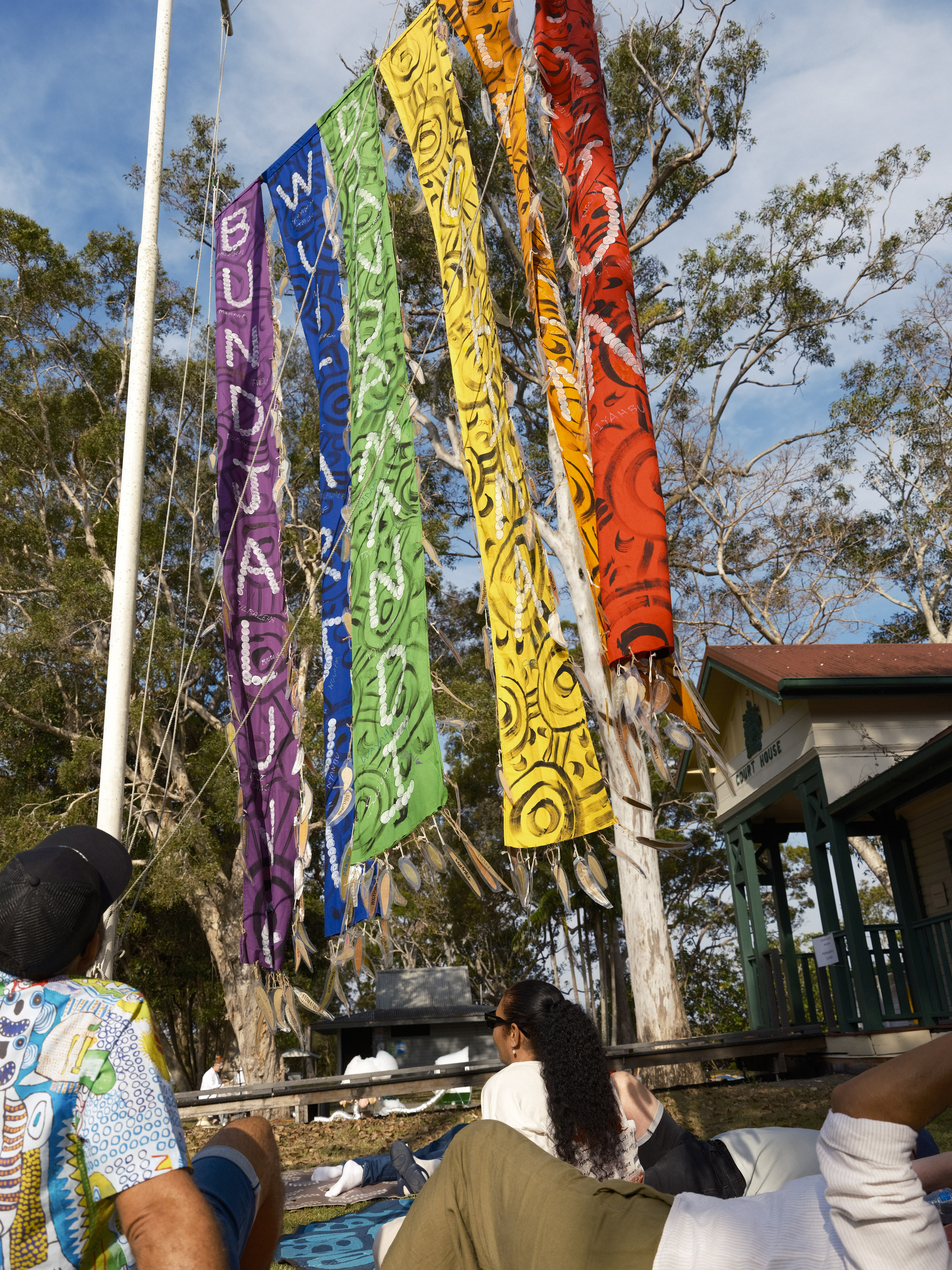
This textile installation reclaimed the courthouse flagpole as a site of memory, resistance, and cultural continuity. Layered translucent fabrics carry fragments of Bundjalung language – place names, kinship terms, ancestral verbs – shifting and overlapping in the wind to reflect the fluid revival of language and story. Laminated leaves, gathered from Country, represent diverse Aboriginal nations and dialects. Though pressed in plastic, they remain living archives – reminders that language is rooted in land, not erased by concrete or colonial law.
Each leaf whispers in its own tongue: Bundjalung, Wiradjuri, Gumbaynggirr, Yuin. Together, they speak of survival. The flag does not ask permission – it rises, it moves, it resists. It transforms a symbol of imposed authority into one of cultural sovereignty. Visitors are invited to lie on mats, listen to Country, and feel the wind carry stories that refuse to be forgotten. This was not just an artwork – it is a breathing act of reclamation.
Jason King is a local Aboriginal artist, born in Murwillumbah and raised in Tumbulgum, who has spent his entire life on Bundjalung Country in the Tweed Valley. Deeply connected to his land and heritage, Jason draws inspiration from Australia’s original storytellers – desert painters, ancient rock art, Aboriginal dance, language, and song. His artistic journey is grounded in a lifelong relationship with nature and a dedication to learning and sharing story, language, and culture. Jason weaves storytelling into each piece, infusing his work with his appreciation for Aboriginal and Islander culture, and hopes his creations resonate meaningfully with his audience.
![]()
![]()
︎
Kyra Togo Come Weave
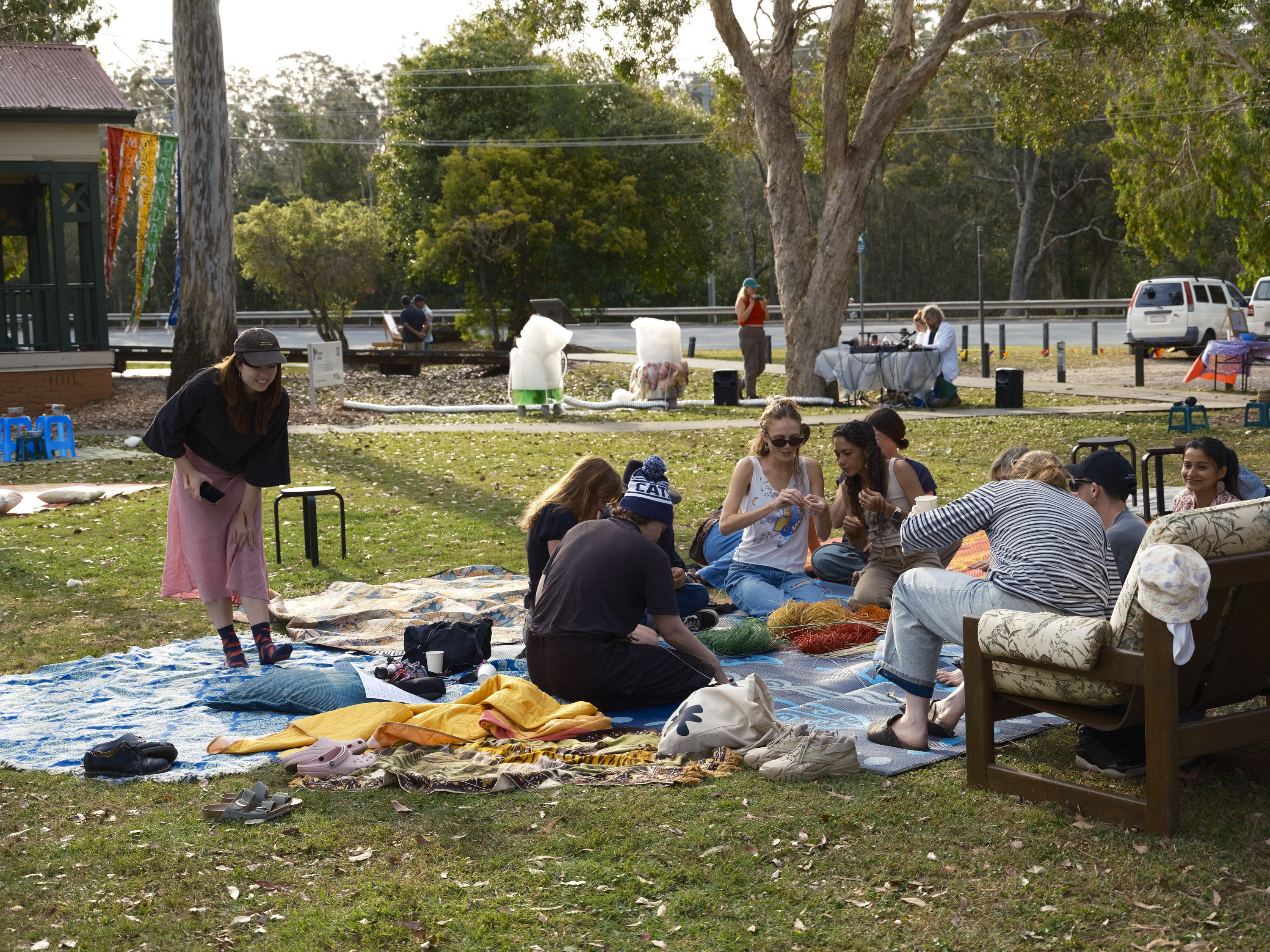
softwash participants joined Kyra Togo for a weaving circle and learned how to make forage bowls for shared meals. As our hands worked with fibre, we reflected on communal care and sustaining relationships with Country and one another.
Kyra Togo is a proud Minyungbal, Tagalaka and South Sea Island woman. Her main medium of expression is weaving, favoring fibers that are most available in her surroundings such as Pandanus, Lomandra as well as Raffia.
Preserving cultural fibre knowledge, Kyra creates woven pieces that embody the beauty in functional artworks. She carries the continuation of weaving craft passed down by her ancestors and is now able to pass that on to her three children while living on Country.
On her journey of reclaiming ancestral knowledge and traditional ways of being, through song, dance and story, weaving is an essential practice that helps her to realign her spirit, to remember the stories of her old people and honouring and respecting Country. Never harming or taking more than is needed to create art and woven works.
![]()
![]()
︎
Gali Guwaay Gulibaa – Water, Words, and Spirit Weaving
Aboriginal meditation and sound healing with Glenn Barry, Gamilaraay.
Glenn invited participants to immerse their Gii Dhuwi – heart and soul with Aboriginal spirituality through heartfelt meditation, sound healing and reflective yarns on sacred country. We deeply listened with calmness and then guwa li – speaking from our inner voices.
Glenn aligns with his Gamilaraay First Nation of Australia and Irish DNA. As a PhD Candidate with the Qld. Conservatorium Griffith University researching the spiritual wellbeing and healing of First Nation music, he works alongside community to support identity agency. He utilises vibrations from the art of Yidaki (Didgeridoo) to bring gii/dhuwi (heart and soul) into the world of authentic feeling. Glenn's goal is clear communication through bridging values of both traditional and contemporary worlds: a “trademporary” world in this 21st Century. Many Bloods. One World.
︎
︎
Ellamay Khongroj Fitzgerald Outdoor Kitchen + Mung Bean Radio
Outdoor Kitchen was a participatory installation that reimagined a dining space, where cooking and conversation became tools for connection. Ellamay Khongroj Fitzgerald prepared congee with a mish-mash of Eastern and Western ingredients, reflecting on her own bi-racial identity and the way she navigates the space between two cultures.
For Ellamay, cooking and eating together has always been a way to reconnect with her father’s side of the family after growing up disconnected from her Thai heritage. Each shared meal builds upon a personal archive of memories, feelings, and stories that help piece together a sense of belonging.
Outdoor Kitchen invited visitors to partake in a bowl of congee and consider, how does sharing a meal change the experience of eating it? What does it mean to gather together, to exchange stories, to taste something unfamiliar yet comforting? Through the act of cooking, serving, and eating, the work creates space for reflection on how food shapes belonging, identity, and connection across cultures.
Mung Bean Radio
“what destroys you can also nourish you.”
Through headphones emerging from a basket of mung beans, Filipino-Singaporean Mariam Ella Arcilla recalls the childhood punishment her grandmother gave her, later transformed into a meal both nourishing and delicious.
Ellamay Khongroj Fitzgerald is an emerging artist based on Yugambeh Country. Her practice spans across lens-based storytelling, installation and participatory forms of making, through which she explores her dual Australian and Thai heritage. Ellamay's work is largely influenced by her lived experiences growing up bi-racial on the Gold Coast and perceptions of culture, identity and place as a second-generation Asian Australian.

︎
Toad Dell Soft Soft Reading Club: Queering Regenerative Design
This intentional practice of Queering interrogates norms to build new relationships and systems that meet the needs of all. In a time and culture of siloed extraction, how do we queer ourselves and the systems we live within? How do we find our edges, locate where they touch others and design a social ecology of strong relationship rather than productivity? Drawing from ecological literacies, systems thinking & permaculture, this space explores how we relate to the everpresent "Other" that is often vilified. Let's practice pausing and deep listening to reveal pathways forward of collaborative and regenerative ways of being.
Toad is a permaculture designer, community organiser and co-founder of PermaQueer. Most of their practice sits at the intersection of social and ecological care with care-full design from a queer theory perspective.
︎
Jason King The Wind Doesn’t Forget
This textile installation reclaimed the courthouse flagpole as a site of memory, resistance, and cultural continuity. Layered translucent fabrics carry fragments of Bundjalung language – place names, kinship terms, ancestral verbs – shifting and overlapping in the wind to reflect the fluid revival of language and story. Laminated leaves, gathered from Country, represent diverse Aboriginal nations and dialects. Though pressed in plastic, they remain living archives – reminders that language is rooted in land, not erased by concrete or colonial law.
Each leaf whispers in its own tongue: Bundjalung, Wiradjuri, Gumbaynggirr, Yuin. Together, they speak of survival. The flag does not ask permission – it rises, it moves, it resists. It transforms a symbol of imposed authority into one of cultural sovereignty. Visitors are invited to lie on mats, listen to Country, and feel the wind carry stories that refuse to be forgotten. This was not just an artwork – it is a breathing act of reclamation.
Jason King is a local Aboriginal artist, born in Murwillumbah and raised in Tumbulgum, who has spent his entire life on Bundjalung Country in the Tweed Valley. Deeply connected to his land and heritage, Jason draws inspiration from Australia’s original storytellers – desert painters, ancient rock art, Aboriginal dance, language, and song. His artistic journey is grounded in a lifelong relationship with nature and a dedication to learning and sharing story, language, and culture. Jason weaves storytelling into each piece, infusing his work with his appreciation for Aboriginal and Islander culture, and hopes his creations resonate meaningfully with his audience.
︎
Kyra Togo Come Weave
softwash participants joined Kyra Togo for a weaving circle and learned how to make forage bowls for shared meals. As our hands worked with fibre, we reflected on communal care and sustaining relationships with Country and one another.
Kyra Togo is a proud Minyungbal, Tagalaka and South Sea Island woman. Her main medium of expression is weaving, favoring fibers that are most available in her surroundings such as Pandanus, Lomandra as well as Raffia.
Preserving cultural fibre knowledge, Kyra creates woven pieces that embody the beauty in functional artworks. She carries the continuation of weaving craft passed down by her ancestors and is now able to pass that on to her three children while living on Country.
On her journey of reclaiming ancestral knowledge and traditional ways of being, through song, dance and story, weaving is an essential practice that helps her to realign her spirit, to remember the stories of her old people and honouring and respecting Country. Never harming or taking more than is needed to create art and woven works.


︎